


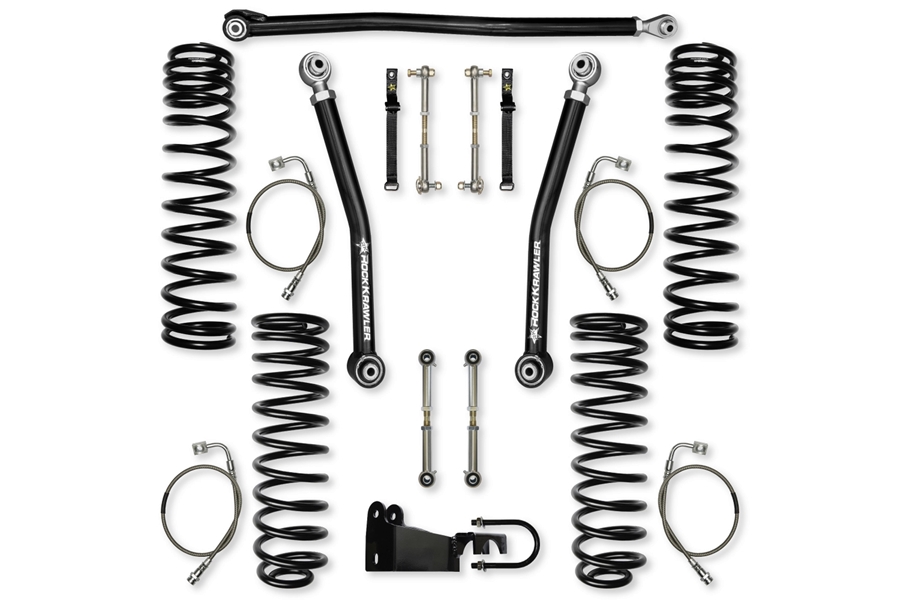


Upgrade your Jeep, truck, or 4x4 with a suspension lift kit built for increased ground clearance, larger tires, and improved off-road capability. Northridge4x4 carries Jeep lift kits and 4x4 suspension systems from leading off-road brands including Rock Krawler, MetalCloak, Clayton Off Road, Teraflex, JKS, ICON, and more.
Whether you're looking for a mild lift for your daily driver or building a Jeep for serious trail and rock-crawling use, choosing the right lift kit starts with your vehicle, desired lift height, tire size, and how you plan to use your rig. Shop lift kits ranging from 0–2 inches and 2.5 inches to 3–3.5 inches, 4–5 inches, and 5.5 inches or more to find the suspension setup that fits your build.
How to Choose the Right Lift KitNot every suspension lift is designed for the same purpose. Before choosing a lift kit, consider your vehicle, tire size, desired ride height, on-road driving, off-road use, and the components included with the kit.
A smaller lift can be a great option for a daily-driven Jeep that needs additional clearance while maintaining road manners. Taller and more complete suspension systems can provide the clearance, suspension travel, and adjustability needed for larger tires and more demanding off-road terrain.
The right lift height also depends on the specific vehicle. Tire clearance can vary based on your Jeep or 4x4's model, wheel offset and backspacing, fenders, bump stops, suspension travel, and other modifications. Always verify the manufacturer's fitment and tire-size recommendations for the specific lift kit you're considering.
What Lift Height Do I Need?Choosing the right lift height depends on what you want to accomplish with your Jeep or 4x4.
0–2 Inch Lift Kits: A good choice for mild builds, additional ground clearance, and vehicles that don't require significant suspension height.
2.5 Inch Lift Kits: One of the most popular options for Jeep owners looking for a balance between increased clearance, larger tire capability, on-road drivability, and trail performance.
3–3.5 Inch Lift Kits: Designed for builds that need additional clearance and suspension travel for larger tires and more aggressive off-road use. Depending on the vehicle and kit, additional suspension and steering components may be recommended.
4–5 Inch Lift Kits: Built for more heavily modified vehicles where increased suspension height, articulation, and clearance are priorities. Taller lifts may require additional drivetrain, steering, and suspension modifications.
5.5 Inch+ Lift Kits: Intended for highly modified and specialized off-road builds. These suspension systems typically require careful consideration of steering geometry, driveline angles, axle components, and other supporting modifications.
Lift Kits and Tire SizeOne of the most common reasons to lift a Jeep is to make room for larger off-road tires. Larger tires can provide additional ground clearance at the axles, improve traction, and help your vehicle navigate rocks, ruts, mud, and other challenging terrain.
The amount of suspension lift required for 33-inch, 35-inch, 37-inch, or 40-inch tires varies by vehicle and build. Lift height alone does not determine tire clearance. Wheel width and backspacing, fender clearance, bump-stop configuration, axle position, suspension articulation, and intended use can all affect what tire size will work properly.
For the best results, select your vehicle and review the fitment recommendations for the specific lift kit before choosing your tire and wheel combination.
What's Included in a Suspension Lift Kit?Lift kit components vary considerably depending on the manufacturer, lift height, and type of suspension system. A basic lift kit may include new coil springs, spacers, or brackets, while more comprehensive systems can include coil springs, shocks, adjustable control arms, track bars, sway bar links, bump stops, brake line components, and other suspension hardware.
More complete suspension systems can offer additional adjustability and help address suspension geometry as lift height increases. Compare what's included with each kit rather than choosing a suspension system based on lift height alone.
Lift Kits With or Without Shocks
Some suspension lift kits include shocks, while others allow you to select shocks separately. Choosing a kit without shocks can give you more flexibility to pair your suspension with shocks that match your budget, driving style, and performance goals.
When shocks are included or offered as an option, make sure they are designed for the lift height and suspension travel of your vehicle.
Short Arm vs. Long Arm Lift KitsAs lift height increases, suspension geometry becomes increasingly important. Short-arm lift kits retain suspension mounting points closer to the factory locations and are common for mild to moderate Jeep builds.
Long-arm suspension systems relocate control-arm mounting points and use longer control arms to help improve suspension geometry and articulation on taller lifts. These systems are commonly used on more aggressive off-road builds, but installation can be more involved.
The right system depends on your vehicle, lift height, intended use, budget, and the level of modification you're comfortable making.
Shop Jeep Lift Kits by VehicleFinding the right suspension starts with proper vehicle fitment. Northridge4x4 carries lift kits and suspension systems for popular Jeep platforms including the Jeep Wrangler JL, Jeep Gladiator JT, Jeep Wrangler JK, Jeep Wrangler TJ, and other Jeep and 4x4 applications.
Selecting your year, make, and model helps narrow your options to suspension lift kits designed for your specific vehicle.
Shop Top Lift Kit BrandsNorthridge4x4 offers suspension lift kits from many of the industry's leading off-road suspension manufacturers. Shop lift kits and suspension systems from Rock Krawler, MetalCloak, Clayton Off Road, Teraflex, JKS, ICON, Bilstein, FOX, and more.
From a mild daily-driver suspension upgrade to a complete long-arm system for a dedicated trail rig, find the components you need to build a suspension system around the way you use your Jeep or 4x4.
Lift Kit FAQsWhat size lift kit do I need?
The right lift height depends on your vehicle, desired tire size, intended use, and other modifications. A 2–2.5 inch lift may be ideal for a mild daily-driver and trail build, while larger tires and more aggressive off-road use may benefit from a taller or more complete suspension system.
What size lift do I need for 35-inch or 37-inch tires?
There is no universal lift height for a specific tire size. Required clearance varies by vehicle, wheel specifications, fenders, bump stops, suspension travel, and intended use. Check the lift kit manufacturer's tire-size recommendations for your specific vehicle before purchasing.
Do I need new shocks with a lift kit?
Not always, but your shocks need to accommodate the suspension's new ride height and travel. Some lift kits include properly sized shocks, while others are designed to let you choose compatible shocks separately.
Does a lift kit improve ground clearance?
A suspension lift increases vehicle and chassis clearance and can provide room for larger tires. Larger-diameter tires are what increase ground clearance beneath fixed components such as the axle differentials.
Will a lift kit change how my Jeep drives?
It can. Changing suspension height can affect handling, steering geometry, driveline angles, and ride quality. A properly designed and installed suspension system with the appropriate supporting components can help maintain predictable on-road handling while improving off-road capability.
Do I need to regear my Jeep after installing a lift kit?
The lift itself generally isn't what determines whether regearing is needed. Larger tires change the vehicle's effective gearing and can affect acceleration, transmission behavior, and overall performance. Depending on your tire size, vehicle, transmission, and intended use, changing axle gear ratios may be beneficial.